
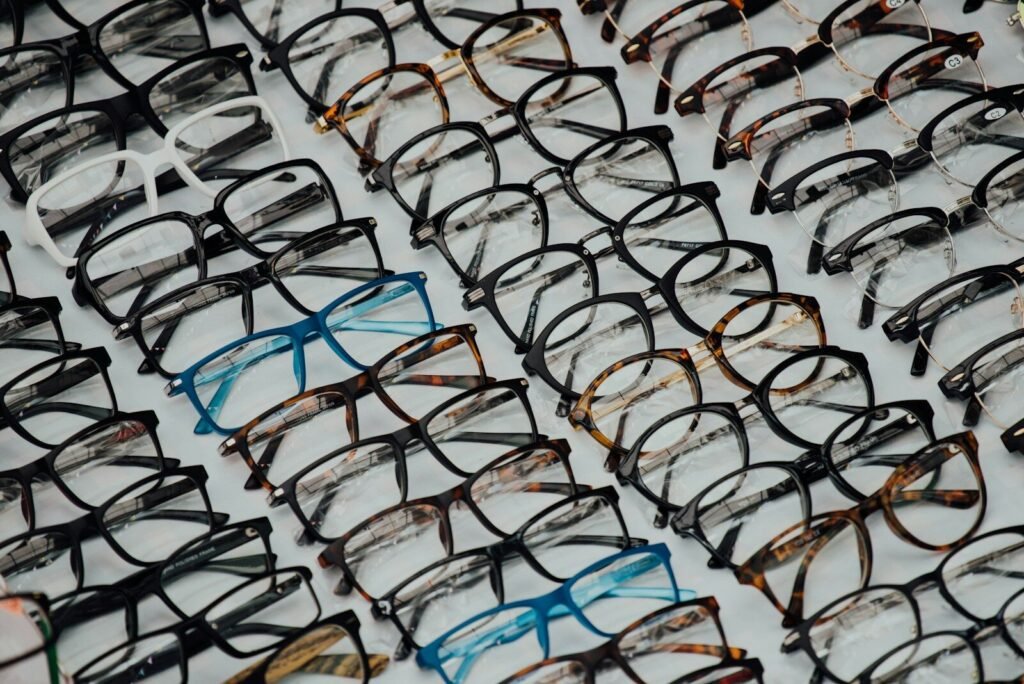
Every pair of glasses has three numbers printed inside the temple arm — something like 52 □ 18 – 140. Those numbers are your frame size, and they are the difference between glasses that sit comfortably all day and glasses that slide, pinch or feel too big. Here is what they mean and how to use them.
What the three numbers mean
- Lens width (52): the width of one lens, in millimetres, measured across its widest point.
- Bridge width (18): the distance between the two lenses, across the bridge of your nose.
- Temple length (140): the length of the arm that runs back over your ear.
The total frame width is roughly twice the lens width, plus the bridge width. So 52 □ 18 is about 122 mm across the front of the frame.
Small, medium and large — a general guide
- Small (narrow faces): lens width under 50 mm, total frame width under about 130 mm.
- Medium (most faces): lens width 51–54 mm, total frame width about 130–140 mm.
- Large (wide faces): lens width 55 mm and above, total frame width above about 140 mm.
These are general guides, not hard rules. If your current glasses fit well, the numbers printed on them are your best reference.
How to measure without a pair to copy
Stand in front of a mirror and measure the widest part of your face — from one temple to the other — with a ruler. Choose a frame whose total width is close to that number: a frame much wider than your face will stick out at the sides, and one much narrower will squeeze. For the bridge, if your current glasses leave marks on your nose, go a little wider; if they slide down, go a little narrower.
Lens height matters too
Progressive lenses need a tall enough lens to fit the distance, intermediate and reading zones — usually at least 28 mm of lens height. That is why very slim, narrow frames are not a good match for progressive lenses, even if the width is right.
Size, lenses and comfort go together
Frame size affects more than looks. With a strong prescription, a smaller frame keeps the lens edges thinner and the glasses lighter. The bridge should rest evenly on your nose without leaving marks, and the temple arms should reach your ears without pressing. Frames with adjustable nose pads are more forgiving on fit.
Not sure of your size?
Tell us the numbers from a pair that fits you, or send us a photo of your current glasses — message us on WhatsApp at +92 328 9695238 and we will help you pick a frame size from our range. You can also read our guide to choosing frames for your face shape before you order.
This article is general information only and is not medical advice. If you have concerns about your eyesight, see an optometrist or eye care professional.